Thursday, October 10, 2013

Book Review: Danger Road by former prosecutor John P Contini

Book Review: Danger Road by former prosecutor John P Contini
By Ray Hanania

As a journalist, I have covered my share of felony court trials, including several involving murder. I’ve seen how painful these trials can be for everyone, especially when a life has been taken.

The public has seen and read about dozens of these cases through the news media. But few have really had a front row seat in a trial where a man’s future faced life or death.

John P. Contini is a highly experienced and high powered veteran of criminal law. A former Broward County felony trial prosecutor based in Ft. Lauderdale in South Florida, Contini used his experience to open his own practice in 1987, this time defending the criminally accused. He has since successfully represented thousands of criminal defendants in Florida and throughout the United States.

One of his cases involved a Miami-Dade police officer, Gilbert Fernandez Jr., who was one of three defendants accused in the killing of three drug dealers who were murdered in 1983. No case is more controversial than when a police officer is accused of involvement in a crime, especially one involving murder and drugs. Seven years later, Fernandez and two other officers were indicted and sat center stage in a high profile trial that received national media coverage.

But Contini fought for his client’s rights against overwhelming odds to a surprising conclusion.

“Danger Road: A True Crime Story or Murder and Redemption” tells the story of the crime, the years between the indictment and the trial. It also tells the story of Fernandez, a former Mr. Florida bodybuilder champion and black-belt karate instructor, whose life transformed as he transitioned in the face of harrowing challenge, finding God.

Contini not only details the crimes, Fernandez’s life transformation and the trial, but he also gives his readers deep insight into the victims, their families, and the accused and their families. So many people suffer and lose in a crime like this on all sides.

With so much public animosity towards the accused police officers, you can imagine the pressures on the judge and the court. Contini writes in his epilogue about the conflicted feelings he experienced, fighting to defend his client, while facing a jury conviction and sentencing.

“When I used to think about the incredible unfairness and illegalities in the trial, I would only think selfishly about the fact that I had been robbed, too. But as I’ve gotten older, I’ve come to realize that the loss of the acquittal and my perception of malfeasance during the trial doesn’t even belong in the same category as the losses suffered by the victims and their loved ones, or the losses experienced by Gil’s family.”

It’s an incredible story that will hold your attention hostage through every page. Real life drama that we only hear about in condensed, news media brevity. The real story can only come out from someone who was embedded in the case from the beginning. Someone who has worked on both sides of the criminal court as a prosecutor and a defense attorney, and from someone who has a powerful and deep sense of religious faith.

Contini is recognized as one of the nation’s top faith-based as well as secular legal authorities on individual rights and freedoms. He can speak with equal authority from both the secular perspective and the faith perspective, citing the statutes or the scriptures when appropriate.

In 2010, Contini was recognized by the National American Arab Anti-Discrimination Committee (ADC) for championing the rights of Husien Shehada. Shehada, on a visit with his brother, had been gunned down by a controversial Miami Beach Police officer with a history of violence and drugs. The ADC Pro Bono Award was presented to Contini during a ceremony in Washington DC to also honor U.S. Attorney Eric Holder. ADC credit Contini’s “selfless fight to defend the rights of Shehada” and “for his outstanding commitment in serving the Arab-American community and for his unwavering assistance to ADC.”

“Everyone has the inalienable right to the best professional legal defense, regardless of guilt and irrespective of the charges,” Contini said. “And I also strongly believe the individual is benefited greatly in more ways than one, when they are reintroduced to faith and develop a renewed hope in moving on with their life."

Contini frequently speaks to church groups, legal conferences, public workshops and conventions about his experiences and his books with a passion that is compelling. He’d love to hear from you.

Danger Road: A True Crime Story of Murder and Redemption
Liberty Press Publishing, 2006
254 pp Softcover
www.JohnContini.com

You can purchase the eBook for each at $3.99. Click the links to get more information, and, if you might consider, please share with your friends.
Danger Road: A TRUE #crime #faith story by active#Florida #criminallawyer John Contini, now available in eBook format! Click here

Feeling the Heat: #addiction TRUE story by #criminallawyer John Contini #faith #crime, now available in eBook format!  Click here

(Ray Hanania is an award winning columnist, author and former Chicago City Hall reporter.)

Saturday, September 14, 2013

Looking for Palestine”, by Najla Said.

Looking for Palestine” by Najla Said.
Reviewed by Barbara Nimri Aziz

If you’ve seen Najla Said perform on stage or spoken to her, reading this
memoir, you’ll feel the same person. “Looking for Palestine” is a
conversational memoir—fresh, youthful, and zesty. Najla’s story and that
of her parents, with her famous father ever present, begins with her birth
and ends with his death when she’s college age. It’s well written, in a
breezy style echoing her theatrical and comedy performances. Still her
light style is underpinned by serious issues—personal psychological ones,
ambiguous relations with the Jewish people who seem to be everywhere, and
the painful inevitability of ‘being Arab’
 whatever that means.

Said’s is a very New York story—upper class Manhattan American with
teenage identity problems — an ‘other’, looking different while still
being conventional except that the family excursions to Beirut are
interrupted by wars.

As a teenager Said becomes only slowly informed about Palestine. She
admits her interests are primarily school, books, friends and music. She
also acknowledges enjoying an upper class life, surrounded by classmates
who while Jewish are more like her than unlike. Indeed she seems to become
aware of her father’s exalted reputation and his mission through these
classmates.

All this Najla Said admits to in this candid, fluid review of her young
and unromantic although quasi exotic life. Very unpretentious. The
revelations have a child’s honest quality, with neither philosophical nor
poetic depth. Just as with her on-stage performances, one feels she is in
fact on stage in this book. But this makes her disclosures no less genuine
and informing.
We are treated to a steady output of memoirs and semi-autobiographical
novels from a new generation of Arab writers, mainly women, mainly
American, telling their story of becoming Arab— from the Iranian hostage
affair, through Sabra-Shatila massacres, the intifadahs, the first Gulf
war on Iraq, and of course the 911 attacks in 2001. Each crisis gradually,
and only gradually, adds to Najla’s maturity—a track many of us took. She
emerges as savvy American artist with a political message.

We are uncertain if Najla’s evolution is special because of a father
rooted in the Palestinian cause, or if this is common to Arab American
youth. Although he’s woven into her story, I suspect Edward Said’s mission
as a nationalist leader was secondary to his daughter. Possibly his
contributions in political thought and literary criticism are more central
to Najla’s own maturity and mission.

This is a valuable story of a young woman--definitely Arab-- growing
through many traumas associated with our ‘being’. Although an all too
frequent experience, this journey has not been told this way before. So,
Najla’s memoir add to the ongoing history of our people in America. With
this book she can reach many in her generation.

Feedback welcome. Go to our comment box at

Friday, July 26, 2013

Book Review: The Muslim Brotherhood, by Author Carrie Rosefsky Wickham


Book Review: The Muslim Brotherhood, by Author Carrie Rosefsky Wickham

When the Arab Spring swept through the Middle East in 2009 and 2010, it should have been obvious to many that the void it would create would not be filled by true Western Democracy, as many believed. Western Democracy was the only Democracy that people could reference. Instead, the void was filled by the most popular movement in the Middle East, the Muslim Brotherhood, the Ikhwan, in Arabic.

Author Carrie Rosefsky Wickham has completed the most recent look at this powerful religious-political movement in her new book "The Muslim Brotherhood: Evolution of an Islamist Movement."

Although the book does not explain the dynamics of recent headlines that resulted in the election of Mohammed Morsi, the Brotherhood's candidate, as the first Democratically elected president of Egypt in June 2012, or the military coup that followed one year later in July 2013, it offers a solid foundation to understand what this movement really was, what it experienced and what it can be about.

Wickham's book is more of an academic review of the Brotherhood's history, heavy with footnotes and more of a dissertation probably not suited for the average reader, it still is the freshest examination of the movement. The Brotherhood is not just a religious political growth in Egypt but has spread throughout the Middle East into Palestine, Syria, Lebanon and Jordan. What happens in Egypt is an indicator of what could and might happen in the other Arab countries where the Brotherhood enjoys widespread religious populist support.

Wickham traces the evolution of the Brotherhood from its founding in 1928 to the recent and failed attempt by Egypt's last dictator Husni Mubarak to destroy it, or at least imprison and arrest its expansion. Mubarak remains in a new prison of the Arab Spring, which continues to swirl with uncertainty through the Arab World. Her work is very detailed and essential to understanding how the current conflict in Egypt under the new "Democratic" military leaders may evolve.

Reading the book, and looking back at its history, it is clear that the Muslim Brotherhood is not something that can be easily swept away even by powerful military leaders in today's Egypt, or even by the secular front of Arabs that is its greatest challenge. Whether they are in prison, in power or on the crest of a new Arab Spring, the Muslim Brotherhood will be around for a long time and will be a major player in defining not only Egypt but the entire Middle East region.

Wickham is an associate professor of political science at Emory University. She is the author of Mobilizing Islam: Religion, Activism, and Political Change in Egypt, and one of the leading authorities on Egyptian politics and history.

Published by Princeton University Press
Princeton, New Jersey, and Oxford, England 2013
360 pages
-- RAY HANANIA

Saturday, May 18, 2013

Book Review blog has been relocated away from Blogger.com because of censorship

The Book Review blog is being relocated because of censorship by Google and Blooger.com.

Here is the new link:

http://rayhanania.com/category/books-films/

I know you will enjoy the new location.

You can still mail your books to:

Ray Hanania
PO Box 2127
Orland Park, IL., 60462

We do our best to review all of the books we receive.

Thanks so much and sorry about the inconvenience caused by Google and Blogger.com Censorship. WordPress offers a high presence on the internet and fewer Google related SEO hassles.

Thanks
RAY HANANIA
www.Hanania.com

Monday, March 4, 2013

The Third Bullet: A Bob Lee Swagger Book 8, by Author Stephen Hunter

The Third Bullet: A Bob Lee Swagger Book 8, by Author Stephen Hunter
Read by Buck Shirner

Click to get info on Amazon.com

John F. Kennedy was more than just a president. He was an event representing the worst tragedy to ever hit my generation. The assassination on Nov. 22, 1963 burned into my memory exactly where I was and what I was doing when someone yelled out "The President has been killed."

It was a horror greater than any of the many great geological tragedies, Tsunamis, hurricanes and tornadoes that have ripped through the world since. At least to me.

And feeding this memory is the deep seated belief that Kennedy was the victim of a conspiracy. He wasn't murdered by just one man, Lee Harvey Oswald, but rather by a group of men with a group of interests that ranged from:

The Mafia being angry they helped elect Kennedy in 1960 by working with then Mayor Richard J. Daley. They stole the election in Chicago from Richard M. Nixon, the Republican vice president. Instead of helping the Mafia by going easy, Kennedy appointed his brother Robert Kennedy who began a purge and aggressive prosecution of the mob

The opponents of Castro living in Florida who pushed the nation into the Bay of Pigs during the administration of Dwight D. Eisenhower that landed on Kennedy's lap, embarrassingly after it was screwed up, making Castro into a hero and later leading up to the Missile Crisis that brought the World to the verge of a nuclear war.

The CIA and that freak show FBI Director J. Edgar Hoover, a closet homosexual who passed judgment against all of his foes for far less, including the Rev. Martin Luther King Jr. and others. Hoover spied on Americans, violated their civil rights, planted false stories and explored embarrassing details including the sex lives of his targets. And King and Kennedy were both fooling around on their wives. Every reporter knew it and Hoover knew it.

And finally, there were those in the government who feared that Kennedy my draw down and lead America out of the Vietnam War.

The Warren Commission report that explored and whitewashed the assassination did so skirting all of these issues, and instead tried to convince the American people that all was safe and no conspiracy existed. It was bad enough that we just experienced the Sputnik episode that bred fear among our people. We didn't need to believe, they thought, that conspirators were manipulating our lives, politics, policies and government.

Jack Ruby, the mob-connected dance club owner who had offices near the Book Depository where they claimed all of the bullets came from the 6th Floor window, murdered Oswald before anyone could know the truth. The conspirators believed that killing Oswald would end suspicion but all any coverup does is make that suspicion worse.

When the Romans tried to erase any memory of Jesus, they built a small temple to the God Aphrodite on the hill where Jesus was crucified hoping that it would erase any memory of the Jewish rebel whose challenge to Judaism and Rome launched one of the world's most powerful religions, Christianity. But all that Temple did was confirm centuries later for the Queen of Constantinople where Jesus had died and they built the Church of the Holy Sepulchre on top of that small Temple. You can see it, and enter it when you enter the huge Christian Church memorial to Golgotha, the Hill of Calvary, and also marks where Jesus was buried.

All of this historical baggage fills my suspicious heart and mind as I read anything about JFK, and the Kennedy Assassination.

Hunter does a great job of weaving into all of this suspicious feeling that my generation will carry to its grave a theory that there had to be someone, and how it could have happened. One of the most disturbing and unexplained events was the murder of J.D. Tippet, the police officer, by Oswald. Why kill him. Why then walk up to him and shoot him point blank in his head as he laid on the ground?

I am not saying I believe Hunter's version, but it explores suspicions that have lingered. Maybe exaggerated a bit with literary license to make a more compelling novel, I am sure. But where there is smoke, there is fire and this book is fire built on the smoldering unresolved remains of the Kennedy assassination.

In three audio files, this book grabs your attention from the very first chapter when an old writer is murdered and his daughter reaches out to someone to get them to explore what she believes is the reason, all tied to the Kennedy assassination.

As we approach the 50 year anniversary of the assassination, the book is worth reading not just for its compelling fascination but for its ability to awaken many of the stirring suspicions that linger in all of our minds.

-- Ray Hanania

Back to Blood, by Tom Wolfe

Back to Blood by Tom Wolfe

I guess when you are a great novelist you can be lazy because that's the only way I can describe this audio book which began with such interest and just dropped dead in what should have been the middle of a plot. Instead, Wolfe takes you through an intricate tale involving the Cuban Community in Florida near Miami -- Hialeah, Little Cuba -- and then stops.

The book is read in such compelling style by Lou Diamond Phillips. Wolfe's writing is phenomenal, of course. He is a great writer. He writes in 3D. Literally. The story unfolds not just in one-dimensional telling of  a story but in a complex multiplicity of levels and no one brings that out better than Phillips.

The story is about sex. Not a lot of sex, but some sex. And it is about a Cuban police officer who is having troubles being accepted by the White police establishment. He's caught between the rejection of both worlds, and that explodes when he finds himself trying to save a Cuban refugee fleeing Castro's Cuba.

Ameriican law is that if you can make it to American soil, the US must grant you sanctuary. But, if you are caught before you step foot on American soil, then back to Cuba you must go. Saving a refugee from hanging from a refugee boat mast puts the refugee on a boat back to Cuba, and that upsets everyone from the Cuban community, to his family Hai Camillo Camacho is his father (what a great name) to his girlfriend who dumps him and ends up hooking up with her employer, a sex therapist and later with a Russia mobster involved in fake paintings that our hero, Nestor Comacho.

Wolfe does a great job exploring the world of Cuban refugees in Florida, the sex trade and the Russian mobsters, as well as racism that exists so graphically.

Yet, Wolfe let's us down.

The book goes no where. There is no dramatic ending. It's almost as if he got to a chapter and just stopped writing. So depressing, yet so much interesting facts weaved into the story about the Cuban community, Cuban culture and race. And he goes into anatomical detail when referring to sex, a noun commonly used -- mons pubis.

Look it up folks. It's that kind of detail, instead of just saying "va-gi-nah" that makes the book so fascinating in detail.

I enjoyed it right up until Wolfe retired writing it. Abruptly. Leaving me hanging. Leaving me wanting more. Come on, Tom. Write. Make an ending that climaxes like the descriptions on every page of the novel.

Monday, December 17, 2012

Extremely disappointed in the Madoff book "The Wizard of Lies" by author Diana B. Henriques

Extremely disappointed in the Madoff book "The Wizard of Lies" by author Diana  B. Henriques

I've read in book or audio book almost every book written about Bernard Madoff, the New York hedge fund financier who stole more than $50 billion in his ponzi scheme that was revealed in December 2008 when he confessed to his two sons, who were highly paid officers of his company.

The Wizard of Lies: Bernie Madoff and the Death of Trust | [Diana B. Henriques]I was looking forward to reading the book "The Wizard of Lies" by Diana B. Henriques, who was the lead writer for the New York Times in covering the Madoff scandal, especially since it was announced that it was the basis for the upcoming HBO movie about Madoff being played by actor Robert DeNiro.

Although the book includes a lot of details gleaned no doubt from her years of covering the scandal, it also includes what looks like a pitch to forgive Madoff's wife and two sons and to exculpate or clear them of any wrongdoing.

It's almost as if Henriques was paid by someone in the Madoff family to make them look good, or maybe she got to close to the Madoff family. It's that bad!

She goes to nauseating lengths to question public beliefs that the wife, Ruth Madoff, and their two sons Mark and Andrew were guilty in the unprecedented ponzi scam. How could his wife and two sons, especially because they were involved in the company, not have been involved? Madoff's younger brother Peter was the Senior Managing Director and Chief Compliance Officer for Madoff's firm. Is it possible that these close family members worked without even a hint of the scam that wa staking place.

Although Madoff is now serving a 150 year federal prison sentence, the fact is that he broke the scam in a private conversation with his two sons and later his wife. That was almost two days before Madoff was arrested. The sons went to federal authorities to report what their father had told them.

Was that staged to protect them? They haven't spoken with him since the confession, and Mark later committed suicide exactly two years after the Ponzi scheme was revealed.

If someone was going to do a movie about Madoff, they might consider doing a fictionalized version since Madoff avoided a public trial where facts and truths would be put to the test, and immediately confessed his guilt. His wife, Ruth, was left with more than $2.5 million, certainly no where near the hundreds of millions they spent in their lavish lifestyle each year, but it is more than enough for her to lvie comfortably.

Henriques goes out of her way to defend Ruth and the sons, questioning without any facts their innocence.

The story HBO should do is one that speculates on the fictionalized reality of what may have happened. Did someone get to Henriques, the lead reporter at the New York Times. Billions of dollars were involved in the scam and many people had much to lose? She writes in defense of Ruth and the family as if she was their PR agent, not an investigative reporter. For example, she offers excruciating detail about Bernie Madoff but very little substantive detail about the actual roles of Ruth and her sons in the Madoff family business.

Why shouldn't the public believe in this speculative treacheries? The fact is that Harry Markopolos handed the Madoff case to the Securities and Exchange Commission at least twice, and hounded the SEC on the topic for years. Why didn't the SEC take the case seriously? Why didn't they do their job? It's almost as if someone at the SEC was protecting Madoff. (Markopolos was a strange character who contributed to the fact that few people believed his "evidence" of a ponzi scheme. He clearly was good at making enemies not believers, though he had a few.)

This book was doing great until the author started her dive in defense of the Madoff family.

It just is not possible that the wife and sons knew nothing. It's more likely that they knew something than not, given their roles int he company and their lifestyle. They had a motive to lie. They could have gone to jail, too.

The fact that the two sons never spoke to their father doesn't suggest as Henriques writes that they were so angry and anguished at their father, but rather than only in a conspiracy of silence (Code of Silence is what the police call it) that two sons would not speak to a father who gave them so much. What did they earn? They were handed their careers and their hundreds of millions that funded their own lavish lifestyle. They had a lot to lose to have spoken to their father. And wouldn't a father warn his sons not to speak to him again for fear they might lose everything? That's the kind of love one might expect from a family of vicious greedy financial jackals.

Henriques doesn't build much sympathy for Madoff but she clearly presents a case the wife and children need.

A court never got a chance to review the facts, so a book by a New York Times reporter would be just as good. Or would it?

Henriques comes across biased, which is not surprising considering she was one of the few if only reporters Madoff agreed to be interviewed by for her book.

What does that tell you? Madoff may have been a liar and a thief, but he is not stupid.

--- Ray Hanania

Wednesday, December 5, 2012

Total Recall: Schwarzenegger's unbelievably fascinating book

Total Recall: Schwarzenegger's unbelievably fascinating book

Total Recall: My Unbelievably True Life Story by Arnold Schwarzenegger has not received a lot of good reviews. In fact, you might observe that the reviews are snarky, nasty and really mean in some cases.

Schwarzenegger was a great actor, a very good governor of California, a decent husband with faults and an author dedicated to minute detail of his life.

Total Recall: My Unbelievably True Life StoryI found the book fascinating. Schwarzenegger offers a refreshing candor and detail that may sound drab and boring to the critics, but describes who he really is. Schwarzenegger is an immigrant from Austria -- maybe the reason why the media hates him so much, they loath anyone from the "Aryan" or Germanic heritages -- a successful body builder, a very good actor and a politician. He married into the Kennedy dynasty, wedding Maria Shriver, the daughter of Sargeant and Eunice Shriver.

He overcome huge obstacles with pure determination and belief in himself to rise up to become one of the most successful and recognized bodybuilders in the World.

He parlayed that into Hollywood movies, starring in several of my absolute favorite films. In his book, Schwarzenegger offers insights and remembrances of events that are fascinating.

I listened to the audio book. Three large files of about 9 hours each.

His story is an immigrant success story. He became governor when everyone said he couldn't, including his wife. Yet he did it. he didn't go off the deep end like former Governor Jesse Ventura, nor did he become the political icon like Ronald Reagan. But he left a lasting legacy in California.

It is amazing how easily the public is manipulated by a partisan and biased media. Many of the writers hate Schwarzenegger. He was a centrist Republican, something liberals loath even more than right wing fanatic Republicans because the centrists are so much harder to discredit.

He overcame many obstacles to become successful and his book should inspire others to pursue their dreams and their goals without fear. Schwarzenegger did it and he hopes you are inspired to do the same.

He doesn't dwell on the most recent news and scandal to haunt his career. He cheated on his wife and had a baby with the woman who was a housemaid. It happened 14 years ago. He didn't even know he had the child until many years later. But Shriver had heard the rumors and confronted Arnold just after Arnold left public life. At least she considered his career. Schwarzenegger talks about that event and apologizes for it. Not with excuses but with genuine remorse. He acknowledges he hurt his wife and his four children. That incident probably more than all the rest have pushed the critics to extremist assault against him.

Whatever Maria does, that is between the two of them. But it doesn't minimize his successful life and his inspiring story of an immigrant with so many things that might hold others back to become the success he did.

I loved the book. I urge you to read it or listen to the audio book, too.

-- Ray Hanania

Monday, November 5, 2012

Hawaii and the tragedy of its real history

Hawaii and the tragedy of its real history
Lost Kingdom: Hawaii's Last Queen, the Sugar Kings and America's First Imperial Adventure
By Julia Flynn Siler

Most Americans probably really don't know and don't care about the tragedy of Hawaii. All they see is a beautiful island of hula dancers and a dream vacation that often gather little more than dust in the bottom of the bucket lists of most Americans who never get to travel there.

Julia Flynn Siler's book "Lost Kingdom: Hawaii's Last Queen, the Sugar Kings and America's First Imperial Adventure" may sound like a boring academic look at a long gone history of the islands, but it instead a compelling narration of how explorers from Britain and later America's Missionaries destroyed the innocence of the Hawaii people.

First, it was Capt. James Cook of the British Royal Navy who accidentally stumbled upon the Hawaii Islands in the late 18th Century while looking for a sea route to Asia's wealth. When his ship landed, the islanders were a complex people with customs, culture and historic rituals dating back nearly two millennium settled originally by natives from the Polynesian Islands.

Cook brought fleas and gonorrhea to the people of the islands which he first named the Sandwich Islands in honor of another British Admiral.

Cook was killed during a battle with islanders but when his men returned to England they brought with them stories of great natural resources, wealth and beautiful naked women.  A few years later, a Methodist Priest Asa Thurston led a group of missionaries to the Sandwich Islands, which were later renamed Hawaii, in the hopes of civilizing the natives there. But in the 80 years since his landing in 1820, the missionaries became greedy prospectors, stealing the land and resources of the island and imprisoning the native Hawaiians with teachings of forgiveness and love -- forgiveness for the foreigner and suffering for the islanders.

By the end of the 19th Century, Hawaii's royal family was deposed and jailed and the descendants of the American missionaries had managed to put most of the land ownership and the economy of the islands in their own control and hands. Hawaii was annexed and in 1959 was incorporated as an American State, against the will of the island's natives.

Siler tells this story in a poignant, detailed manner. It's a compelling narration of destruction and tragedy. Beauty destroyed by the missionaries who were driven by evil interpretations of the Bible.

The story of Hawaii is tragic beyond comprehension. Man of the natural resources of the island were destroyed and driven to extinction, while imported resources like sugar and pineapples were exploited into industries controlled by the "Hawlay" or White People as the native Hawaiians called them.

I remember as a child how America celebrated the embrace of Hawaii. We were told that the Hawaiian people wanted to become a part of America, but we were never told the truth of how American businessmen and robber barons stole much of what is now an American colony.

America can claim many great accomplishments. But the story of Hawaii and the imprisonment of their culture, transforming it into a cheap tourist industry now overshadowed by the many Pacific battles of World War II that began with the Japanese attack against pearl Harbor in Oahu on Dec. 7, 1941.

This is a must read book that will open the reader's eyes to the truth. In 1993, President Clinton and the US Congress offered an apology to the people of Hawaii on the 100 year anniversary of the island's annexation by the United States. Later under President Obama, legislation was introduced to grant special status to the native Hawaiians similar to the rights given to the Native Americans on the American continent.

Too little, too late. But it's not too late to know the truth of this beautiful island's sad and tragic history.

Click here for more details.

-- Ray Hanania

500 Days, Kurt Eichenwald's eye-opening expose on the secrets and lies of the "war on terror"

500 Days, Kurt Eichenwald's eye-opening expose on the secrets and lies of the "war on terror"

Americans were consumed with emotions in the wake of the horrible murder of nearly 3,000 Americans on Sept. 11, 2001 that it is not surprising that many lies and exaggerations that played to the public's screams for revenge went unchallenged for years after.

But now, more than a decade since the horrific terrorist attacks that toppled the World Trade Center's Twin Towers in New York City, damaged the Pentagon and threatened destruction of the White House or the Congress, Americans might be ready for some truth when it comes to what we did and what we didn't do in response tot he terrorism.

Certainly Osama Bin Laden deserved his fate, killed in a late night assault by Navy Seal Team 6 on his home in a suburb of Pakistan earlier in May 2012. So many terrorists have been arrested and follow-up terrorist attacks have been thwarted since.

The extremes that Americans were taken by their drive for revenge, and the compromises of our principles and morals that were thrust upon the willing public by leaders driven by anger and vengeance, surely went far beyond what was justified.

No other author has had the courage to confront the lies in more documented detail than writer Kurt Eichenwald in his detailed look back on the events of the first 500 days after Sept. 11, 2001, "500 Days: Secrets and Lies in the Terror War."

The book is a painful examination of the shortcuts on the fundamental principles that define America as the "leader of the free world." The most distressing stories involve the individuals who were arrested in Afghanistan or who were "identified" by other prisoners as being al-Qaeda terrorists when in fact they were innocent of any involvement in the terror crimes.

Dozens of innocent people -- maybe even hundreds of thousands -- were arrested and not only put in prison where their rights to defend themselves were denied under the pretext of fighting a war on terrorism, but they were tortured by American soldiers at Guantanamo and sent to be tortured by terrorist regimes that the United States has denounced, like Syria.

So troubling are some of the stories that Eichenwald details. Suspects were literally grabbed from the street after the United States offered to pay fortunes to anyone who would turn in an al-Qaeda operative. People were turning in their neighbors and rivals and without even double checking the facts, those turned in were grabbed and imprisoned and taken from their families without any information or ability for the civilians to defend themselves. Vice President Dick Cheney and Secretary of Defense Donald Rumsfeld ordered the prisoners to be arrested while the Justice Department labored to find ways to undermine the fundamental core values of our American judicial system to justify their criminal acts.

People were tortured to the point where they were forced to lie, lies that were then used as the basis of deciding how American military personal would engage the conflict, putting our soldiers' lives in jeopardy. In many cases, torture failed to produce any reliable results. Eichenwald details how the FBI managed to extract much useful information from real al-Qaeda prisoners through normal interrogation techniques only to have the results thrown out and the techniques replaced with physical torture by the CIA. The CIA and Cheney and Rumsfeld would then use the information obtained by the FBI to claim that they had extracted the information through the use of torture.

Americans were lied to and American soldiers were pushed to act like animals in their misconduct and war crimes against innocent civilians who were not involved in terrorism, but were suspected of terrorism because of their names, their religion and the physical appearances as people from the Middle East.

That no one in the United States even cared about all this is even more distressing, especially since the same torture techniques that were used by Americans will probably one day be used on American prisoners of war by our enemies.

The book is lengthy and detailed, but it is a compelling story that will captivate anyone who still believes that somewhere in today's America lie the ruins of a powerful Constitution and the principles of freedoms and civil rights.

This has been one of my favorite audio books so far.

-- Ray Hanania

Thursday, October 11, 2012

12:21 a novel by Dustin Thomason

Fiction: 12:21, a novel by Dustin Thomason

12.21: A NovelDustin Thomason's novel "12:21" explores the myths of the Mayan "long" Calendar which ends on Dec. 21, 2012.

The novel takes through a somewhat tortuous story line in which a Mayan descendant leaves an ancient Mayan city ruin carrying a disease similar to Mad Cow disease, and spreads it through the world.

Historically, Thomason offers some insight into the Mayan Calendar, but his writing style is stilted. Difficult to read. Not an easy flow.

Probably the best part oft he novel is his recreation of the ancient Mayan civilization and a fictionalized account of a brutal Mayan leader who turns to cannibalism. The story is built around the Mayan leaders scribe and the detail about ancient Mayan life brings this novel to life. Tragically, everything else is a let down.

It's very predictable. The events. The scenes. The dialogue.

The audio book is about 11 hours long.

Here is the book summary from Amazon.com:

From the co-author of the two-million copy mega-bestsellerThe Rule of Four comes a riveting thriller with a brilliant premise based on the 2012 apocalypse phenomenon—perfect for readers of Steve Berry, Preston and Child, and Dan Brown.
 
For decades, December 21, 2012, has been a touchstone for doomsayers worldwide. It is the date, they claim, when the ancient Maya calendar predicts the world will end.
 
In Los Angeles, two weeks before, all is calm. Dr. Gabriel Stanton takes his usual morning bike ride, drops off the dog with his ex-wife, and heads to the lab where he studies incurable prion diseases for the CDC. His first phone call is from a hospital resident who has an urgent case she thinks he needs to see. Meanwhile, Chel Manu, a Guatemalan American researcher at the Getty Museum, is interrupted by a desperate, unwelcome visitor from the black market antiquities trade who thrusts a duffel bag into her hands.
 
By the end of the day, Stanton, the foremost expert on some of the rarest infections in the world, is grappling with a patient whose every symptom confounds and terrifies him. And Chel, the brightest young star in the field of Maya studies, has possession of an illegal artifact that has miraculously survived the centuries intact: a priceless codex from a lost city of her ancestors. This extraordinary record, written in secret by a royal scribe, seems to hold the answer to her life’s work and to one of history’s great riddles: why the Maya kingdoms vanished overnight. Suddenly it seems that our own civilization might suffer this same fate. 
 
With only days remaining until December 21, 2012, Stanton and Chel must join forces before time runs out.

-- Ray Hanania

Monday, October 1, 2012

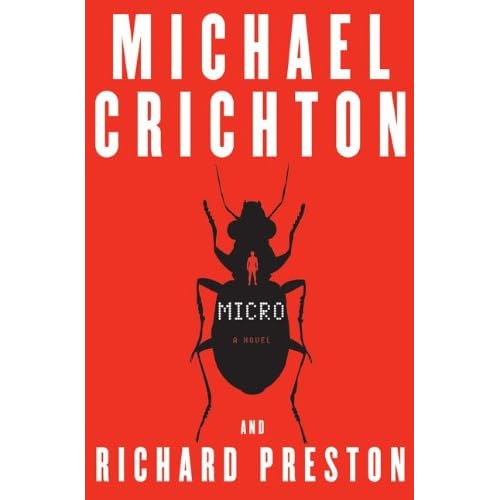
Micro by Michael Crichton

Micro by Michael Crichton

This was one of my first audio books and it was phenomenal.

The story may be unbelievable but is any science fiction techno-thriller believable these days?

The book is well written. The plot is tight. Basically, it's a story about a greedy corporate CEO who starts killing off people to preserve his profits.

But the real attraction of the book is the phenomenal detail that Crichton offers in terms of the insect world. In the book -- without giving anything away -- a group of students are miniaturized and they end up in a nearby rain forest. What they go through fighting off ants, beetles, wasps, bats and spiders is an exciting read.

Although the book is for mature readers, kids would love the story of how little people have to struggle to stay alive with now giant insects and animals surrounding them. How insects eat, breath and conduct themselves is offered from a close-up perspective or a micro-human being. Crichton describes home a wasp lays its eggs in a live host. How insects sense other potential prey in their environment.

I purchased this one on audio book and listened while in the Health Club. It made the workouts go by fast. I mean the narrative is that good that you lose a sense of time reading it. You get fully absorbed.

Click here for the book's info on Amazon.com.

I highly recommend Micro. It is a fast and capturing read.

-- Ray Hanania